

AI Concentration and the Broader Opportunity
November 19, 2026
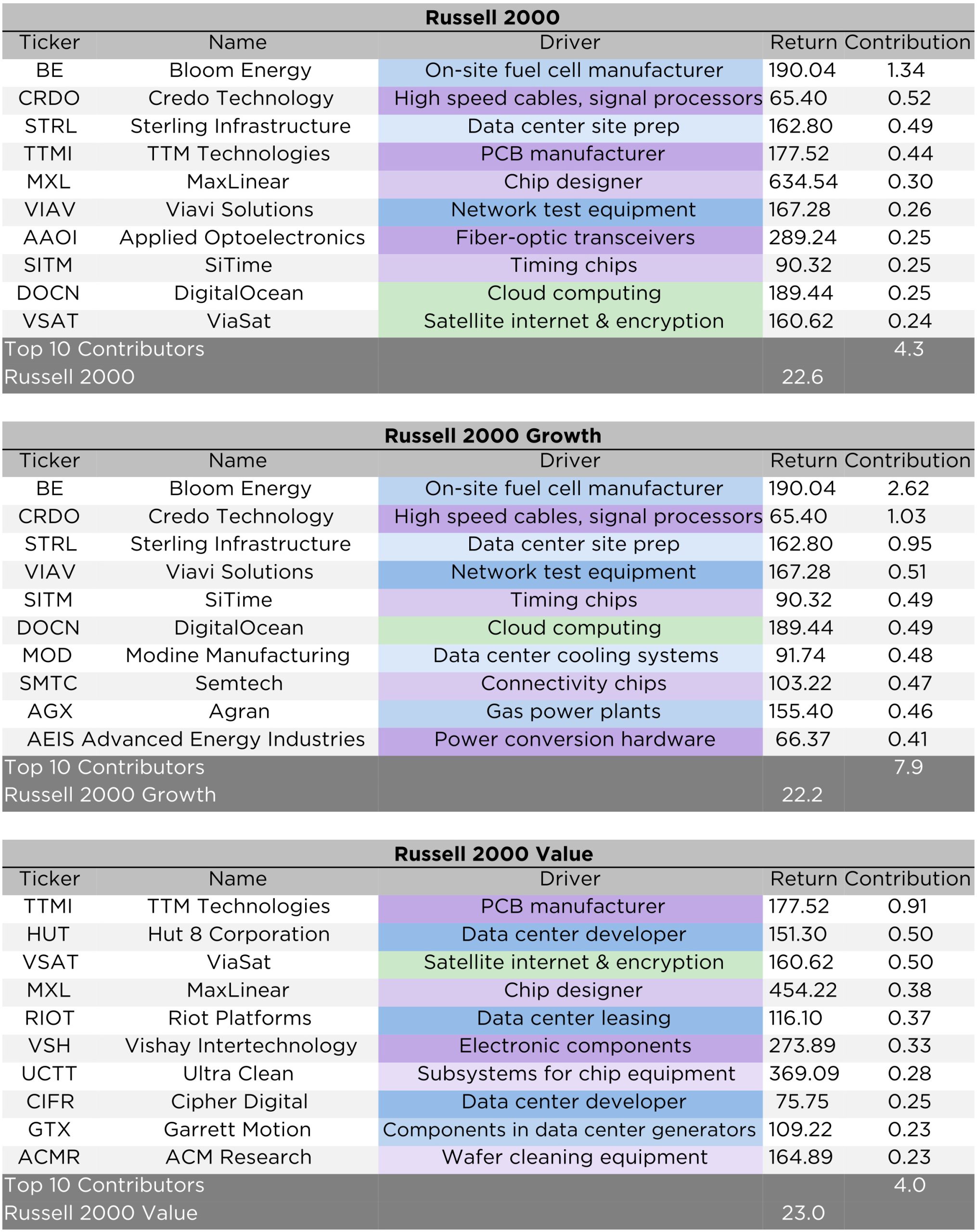
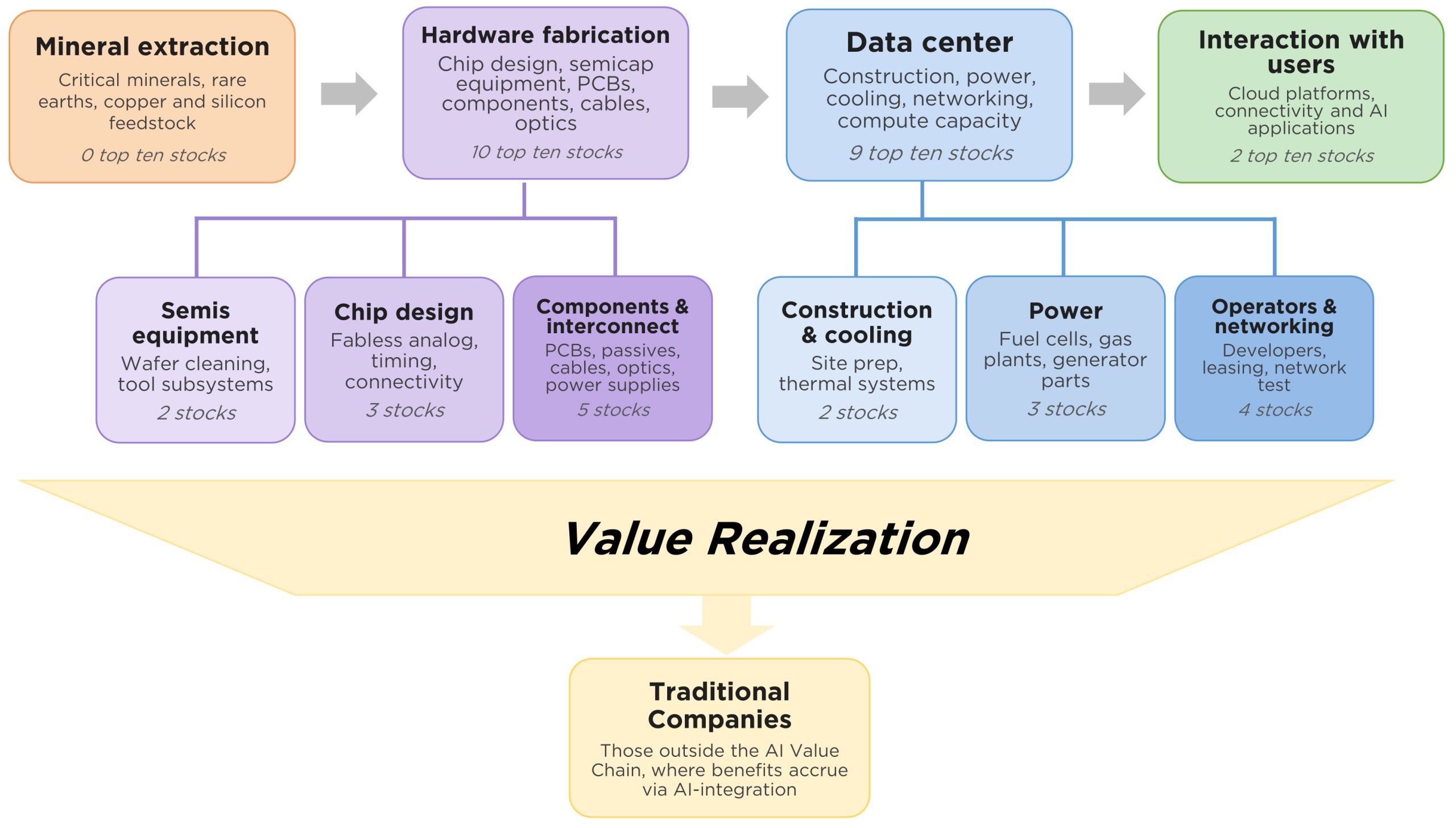
The magnitude to which the AI trade is driving Large Cap indices has been widely discussed. Investors, however, may be surprised by how much the trade is impacting Small caps as well; the trade drove every stock in the top ten contributors for Small across all three style segments year to date. The top performers continue to shift down the AI value chain; with mineral extraction-related names having seen their big runs in 2025 and early 2026, the stocks that drove performance in the most recent quarter were primarily hardware fabrication- and data center-related companies.
Year to date top 10 Small Cap index contributors
Every stock – across each style – was driven by the AI narrative
Top Contributors
AI Value Chain: where top YTD contributors exist
Source: Hudson Edge Investment Partners, Jefferies, FactSet
Through 9/30/2026. AI attribution reflects Hudson Edge Investment Partners’ analytical judgment. “Driver” is shaded to match the box each company serves, with sub-section shade used where one exists. Counts are unique tickers across the three indices.
The final step in the AI value chain is where workflow integration takes place, and benefits accrue to “regular” companies. End-users are the technology’s ultimate monetization layer, where value realization lies. While infrastructure providers (like Nvidia) and model builders (like OpenAI) create the capabilities, the actual economic value is only realized when enterprise adopters embed these tools into their operations to increase revenue or cut costs. As AI moves downstream, the question will shift from “who is spending on AI?” to “who actually earns an attractive return on that spending?” Companies will differ dramatically on this front. AI is moving from a broad, obvious theme into more complex phases, where the dispersion between winners and losers should increase.
The recent AI-driven selloff has been concentrated in the earlier stages of the AI value chain, particularly in semiconductors, infrastructure, and data-center-related businesses, where expectations and valuations have risen alongside substantial capital investment. The market is questioning the economics of building AI infrastructure, not necessarily the longer-term economics of using AI. While investors reassess the pace and returns of that spending, the longer-term opportunity for companies further downstream remains largely intact and unappreciated.
As AI adoption broadens, opportunities will increasingly emerge among companies able to translate productivity gains and operating efficiencies into tangible improvements in profitability. Ultimately, we believe the future of the market will be defined less by thematic exposure and more by what individual companies can deliver. In our view, these “regular” companies currently offer a more attractive risk/reward profile, with upside from AI-driven productivity gains that valuations have yet to reflect and less downside risk from the unwinding of elevated expectations. With investor capital concentrated in the AI trade, many of these overlooked businesses trade at attractive valuations, creating opportunities to buy quality at a discount while potentially limiting downside exposure in an AI-driven selloff. We believe the environment will increasingly reward disciplined stock selection, as sustainable returns on capital, rather than thematic enthusiasm, becomes a primary driver of long-term returns.
The views, opinions, and analyses expressed herein are those of Hudson Edge Investment Partners, Inc. (“Hudson Edge”) as of the date of publication, are subject to change without notice, and may not reflect subsequent market developments. This material is provided solely for informational purposes and does not constitute investment advice, an offer to sell, a solicitation of an offer to purchase, or a recommendation to buy, sell, or hold any security or financial instrument.
Certain statements may constitute forward-looking statements based on current expectations, estimates, assumptions, and judgments. Actual events and outcomes may differ materially from those expressed or implied. Any assessments regarding individual companies, including their exposure to artificial intelligence, anticipated developments, or factors influencing security performance, represent Hudson Edge’s analysis and judgment and should not be construed as statements of established fact or guarantees of future results.
All investments involve risk, including the possible loss of principal. Past performance is not indicative of future results, and there can be no assurance that any investment objective will be achieved.
Certain information has been obtained from third-party sources believed to be reliable but has not necessarily been independently verified. Hudson Edge makes no representation or warranty as to the accuracy or completeness of such information. The information presented is not tailored to any investor’s individual circumstances, and investors should consult their own professional advisers before making investment decisions. Hudson Edge undertakes no obligation to update this material except as required by applicable law. Nothing herein is intended to limit any rights or remedies available under applicable securities laws.

Portfolio Manager